



Side profile of a bearded man wearing a dark gray baseball cap and a gray T-shirt against a plain off-white background.

Boiler tune-up before winter in League City, TX

Step 1 of 3: Equipment

Should I get my boiler tuned up before winter in League City?

Winter doesn't ask much of a boiler here, and that's exactly why it's easy to put this off. You're not firing it up through months of hard freezes like someone further north, so the thought is natural: why bother tuning up a system that barely runs? But a boiler that sits idle most of the year has its own way of failing, and the first cold snap is usually when you find out about it.

Yes, and the slow start here is exactly the reason

A boiler that sits unused for most of the year doesn't fail gently. Mineral deposits settle, seals dry out, and a pilot or igniter that hasn't fired in months can refuse to light when you finally need it. Winters around League City are mild, so your boiler might only run for a handful of weeks, and that short, irregular use is harder on it than steady winter operation would be. A tune-up before the cold arrives means a technician checks the burner, the pressure, and the controls while there's no rush, instead of you finding a dead boiler on the one cold morning you need heat. Most homes here lean on electric heat anyway, so your boiler is likely a smaller part of the house, but it still has to work the few times you call on it.

A man in a blue sweatshirt reclines with his eyes closed in an armchair in a living room, with a folded newspaper and ceramic mug on a side table and bookshelves and a couch behind him.
A bearded man in a navy sweater leans back in a brown leather armchair with his eyes closed and a slight smile, beside a window and a side table holding newspapers and a lamp.
A man in a dark gray sweater reclines with closed eyes and a slight smile in a brown leather armchair in a living room with bookshelves, a sofa, a lamp, large windows, and a folded newspaper on a round wooden table.
A man in a gray fleece pullover sits in a leather armchair with his eyes closed and a slight smile, beside a table with newspapers and a lamp, with a window, potted plant and bookshelves behind him.

Tune It Up or Wait and See

Skip it this year

  • If the boiler ran fine last winter, it will likely light and heat the same way this time without a visit from anyone.
  • A boiler with a standing pilot keeps working through a power outage, which covers most of what people worry about going wrong.
  • You save the cost of a service call now, though nothing checks the pressure, the venting or the igniter before the first cold night.
  • A small problem, a cracked heat exchanger or a failing igniter, stays hidden until the system won't fire on the morning you need it.
  • Most of the year this boiler sits unused here, so a fault can sit with it unnoticed for months.

Have it tuned up

  • A technician checks the pressure, the venting and the burner before winter asks the boiler to run at all.
  • Catching a worn igniter or a failing sensor now means it gets fixed on a mild afternoon, not during a cold snap.
  • A local contractor who services boilers in Galveston County year-round knows which parts tend to fail in systems that sit idle most months.
  • One contractor gets your request, so you're dealing with a single visit instead of fielding calls from several companies.
  • Once the boiler's checked, you're not thinking about it again until next fall.
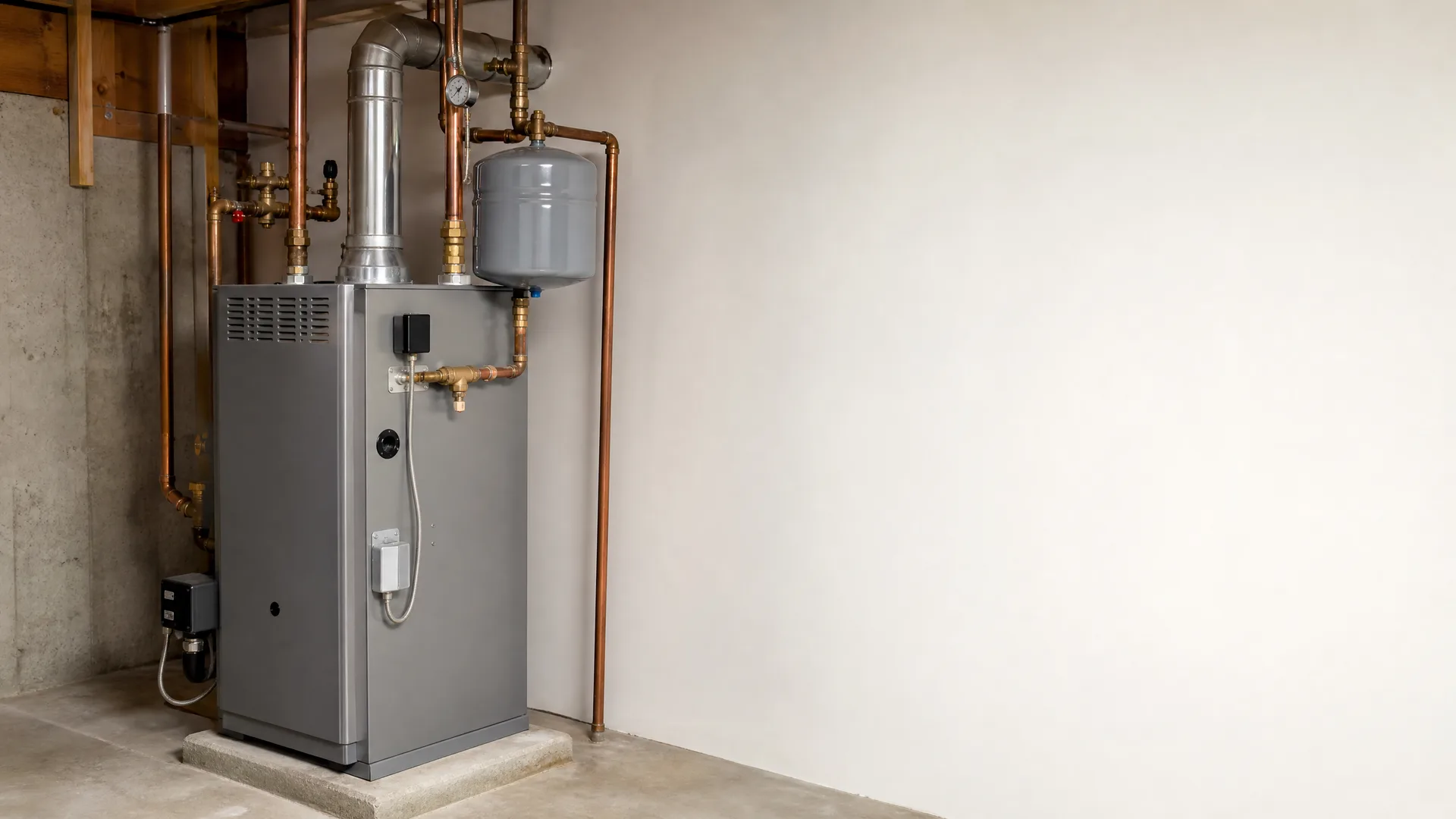
A gray boiler unit on a concrete pad in a basement corner, connected to copper piping, a metal flue vent, and a gray expansion tank, beside a plain light-colored wall.

Why a boiler still needs a look

A boiler that ran fine last winter can still have a buildup of scale or sediment in the heat exchanger, and that buildup makes it work harder to get the same heat into your house. It won't always show up as a problem you'd notice right away. A gas valve or igniter that's starting to go can still fire the burner most of the time, right up until the morning it doesn't. A yearly check catches that kind of wear before it decides when to show itself.

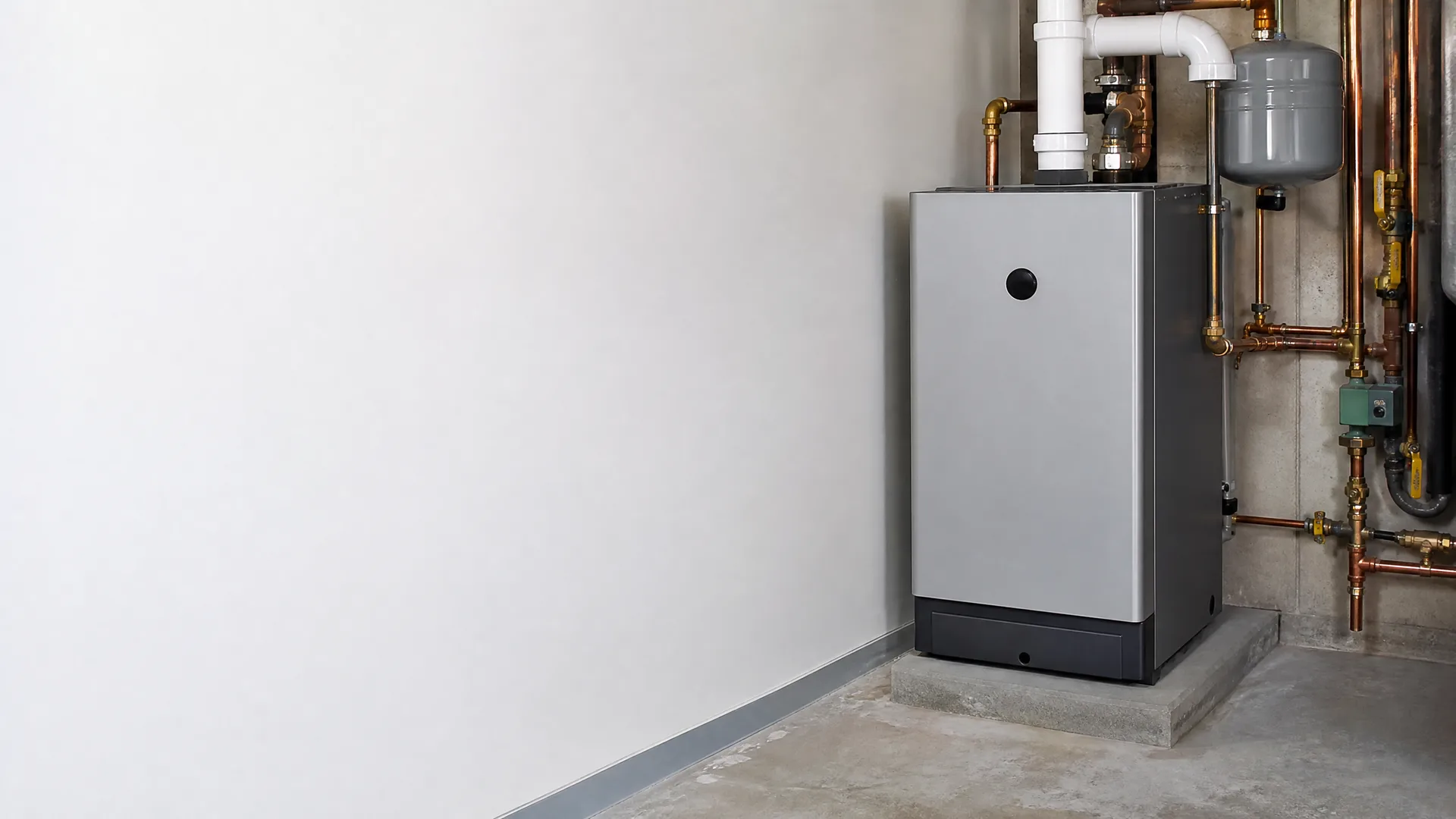
A gray floor-standing boiler on a concrete pad in a basement corner, connected to copper and white plastic pipes, valves, a circulator pump, and a gray expansion tank against a concrete wall.

What actually gets checked

A tune-up means someone looks at the burner flame, the venting, the pressure relief valve and the water level, and tests the controls that shut the system down if something goes wrong. None of that takes long when a boiler's been running right. It's the same visit whether your system is five years old or twenty, and it's worth more the longer it's been since anyone last looked at it, especially if it came with the house and you don't know when that was.

How cold does it actually get for your boiler here?

  • Winter nights average 48°F

    Winter nights average 48°F here, which is cold enough to call for heat but not cold enough to run a boiler hard or often.

  • Heat runs December through February

    Heat runs December through February, so a boiler tune-up before those three months is the only check it gets all year.

  • 51.6% of homes heat with electricity

    Electricity heats 51.6% of homes in the county, so a gas or electric boiler here is already working less than the furnace crowd assumes.

NOAA nClimDiv 1991-2020 · ACS 2020-2024

What a short visit catches

A technician checks the pilot or ignition, the vent, and the water pressure, and looks for scale in the heat exchanger. If the burner is sooting up or the pressure's drifted low, that's the visit where it gets caught, before it turns into a boiler that short cycles or won't hold a flame on the one cold morning you need it. None of this takes long to check. What it saves you is the week in January where you're without heat and waiting on a repair instead of a tune-up, with your family cold in the house while it gets sorted out.


What skipping it risks

Nothing happens most years. The boiler lights, the house warms up, and the visit you skipped never gets noticed. But a buildup of scale doesn't reverse itself, and a pilot assembly that's starting to fail doesn't fix itself either. Skip enough winters and the boiler is working harder than it should for the same heat, which shows up on your power bill since most homes here run electric. The risk isn't a frozen house. It's a slow loss of efficiency and a system that fails on the one week you actually need it.

An older man with gray hair and a beard, wearing a dark blue fleece zip jacket, leans back in an upholstered chair with his eyes closed in sunlight near large windows, with a potted green plant and bare trees behind him.
A woman in a cream knit sweater sits with eyes closed in a light upholstered armchair beside a window showing autumn foliage, with a ceramic mug on a side table and a lit lamp and shelves in the background.

One request and it's handed off

A boiler in League City doesn't get pushed hard. Mild winters mean it may only run a few hours a night, December through February, and that light use is exactly why a problem can sit unnoticed. Scale in the heat exchanger or a pilot that's starting to drift doesn't announce itself when the system barely runs. It just quietly costs more to heat the house, or waits for the one cold snap to fail. Finding someone to look at it before that happens is its own small chore, and most people put it off for the same reason they put off the tune-up itself. One request here goes to a local contractor who services boilers like yours all year, in a county where most homes don't even have one, and knows what tends to go wrong in a system that only runs part of the year. That's one call off your list before the first cold night shows up.

Inside a boiler tune-up

  • A tune-up starts by shutting off gas and power before anything gets opened up or tested.
  • The technician pulls the burner cover and checks the flame, looking for yellow tips or soot instead of a clean blue cone.
  • Water pressure gets checked cold, since a reading that looks fine hot can mean a slow leak somewhere in the system.
  • The condensate line, if your boiler has one, gets cleared since a clog there can shut the whole unit down.
  • Electrical connections at the control board get snugged up, since a loose one is a common reason a boiler won't fire on the first call.
  • The expansion tank gets checked for the right air charge, since a waterlogged tank can't absorb pressure the way it should.

Gas and power come off first, before a cover gets pulled or a gauge gets checked. That's not caution for its own sake, it's so nothing fires while someone's hands are in the burner compartment. With the cover off, the flame tells its own story. A clean flame burns blue in a tight cone. Yellow tips or soot on the burner mean it's not combusting the way it should, and that's worth catching before the gas bill or the heat exchanger pays for it. Water pressure gets read cold, not hot, because a system that looks fine under heat can still be losing water slowly, and cold is when that shows. If your boiler vents through a condensate line, that line gets cleared, since it's a narrow path and it only takes a small clog to shut the whole unit down until someone finds it. At the control board, the connections get checked and snugged up. A loose wire there is one of the more common reasons a boiler won't light on the first try, and it's a five-minute fix when someone's already looking. Last comes the expansion tank, checked for the right air charge. When that charge is low, the tank fills with water instead of air and can't absorb pressure the way the system needs it to, which shows up later as pressure swings that seem to come from nowhere.

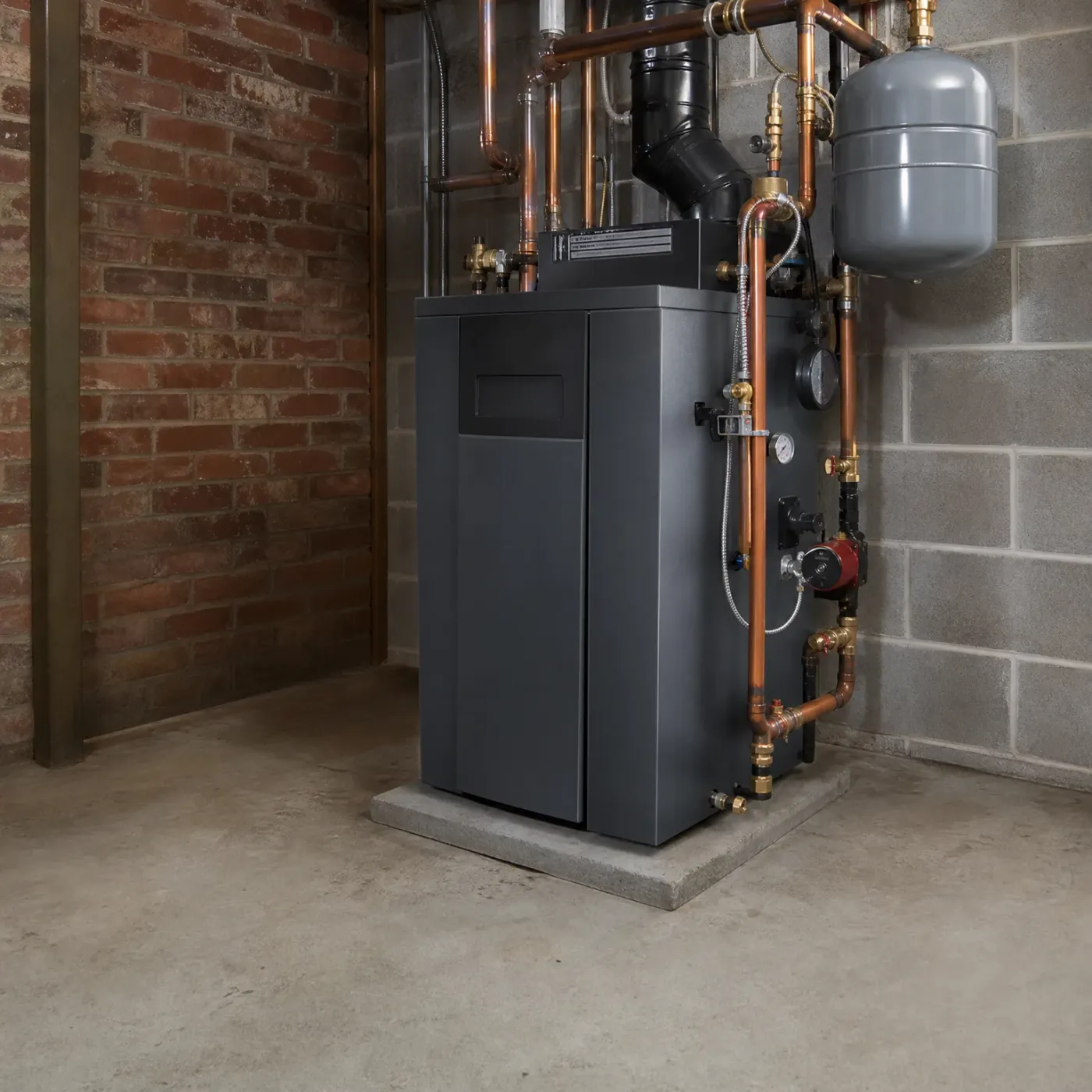
A dark gray floor-standing boiler on a concrete pad in a basement, connected to copper piping, valves, a circulator pump, a gauge, a black flue pipe, and a gray expansion tank, with a brick wall on the left and concrete block wall behind.
A boiler that gets looked at before winter keeps its pressure steady and its burner flame clean, so it runs the way it did when it was new.
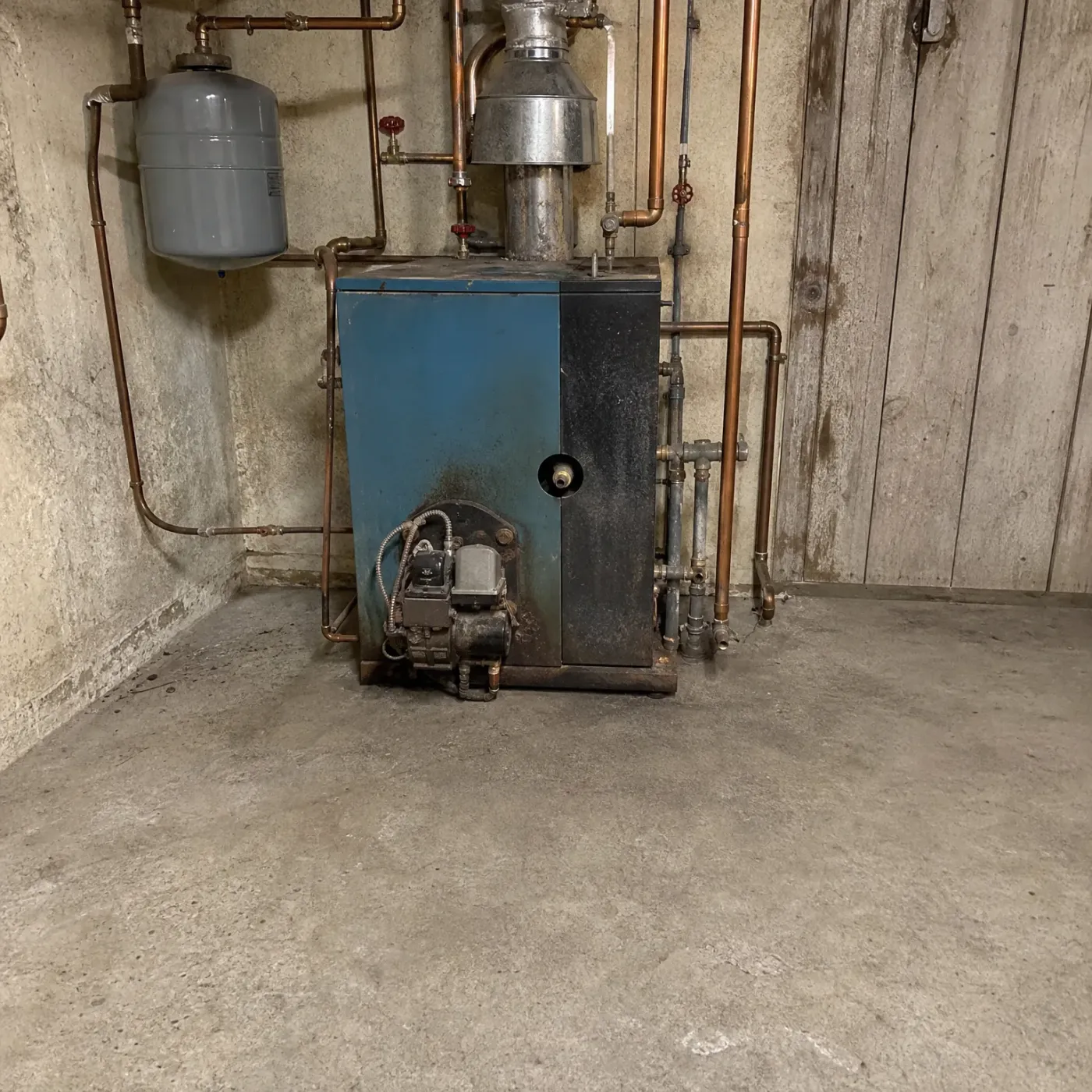
A blue and black boiler with a burner unit, flue, expansion tank and copper and steel piping stands on a concrete basement floor against a concrete wall and wooden plank partition.
A boiler left alone for years builds up scale in the heat exchanger and soot on the burner, and that's what leads to a no-heat call.

A thorough visit goes past the burner and into the parts that cause trouble quietly. Draining a bit of water and checking the expansion tank's air charge tells the technician if the system is waterlogged, which is what causes pipes to bang when the heat kicks on. The gas valve's regulator gets checked against the manifold pressure spec, since even a small drift there changes how the burner fires. A combustion analyzer goes into the flue to read carbon monoxide and oxygen levels, numbers no one can get by just looking at the flame. The circulator pump gets checked too, since a seized bearing or worn seal can leave some rooms cold while others heat fine. The low-water cutoff gets tested to confirm the boiler shuts itself down if the water level drops, which matters even on a system that barely runs most nights. And any corrosion near a fitting or the relief valve gets noted, since a slow drip now is often the early sign of a bigger failure still months off.

Inside the tune-up itself

  • Draining a cup of water from the boiler and checking the expansion tank's air charge catches waterlogging before it causes banging pipes.
  • The technician checks the gas valve's regulator setting against the manifold pressure spec, since a drift of even a few inches of water column changes how the burner fires.
  • Combustion analysis with a probe in the flue reads carbon monoxide and oxygen levels, numbers a visual check of the flame alone can't catch.
  • The circulator pump gets checked for a seized bearing or a worn seal, since either one can leave rooms uneven or cold even with a working burner.
  • Low-water cutoff testing confirms the boiler shuts itself down if water level drops, a safety check that matters even on a system that runs lightly all winter.
  • Any corrosion near fittings or the relief valve gets flagged, since a slow drip there is often the first sign of a failure that's still months away.
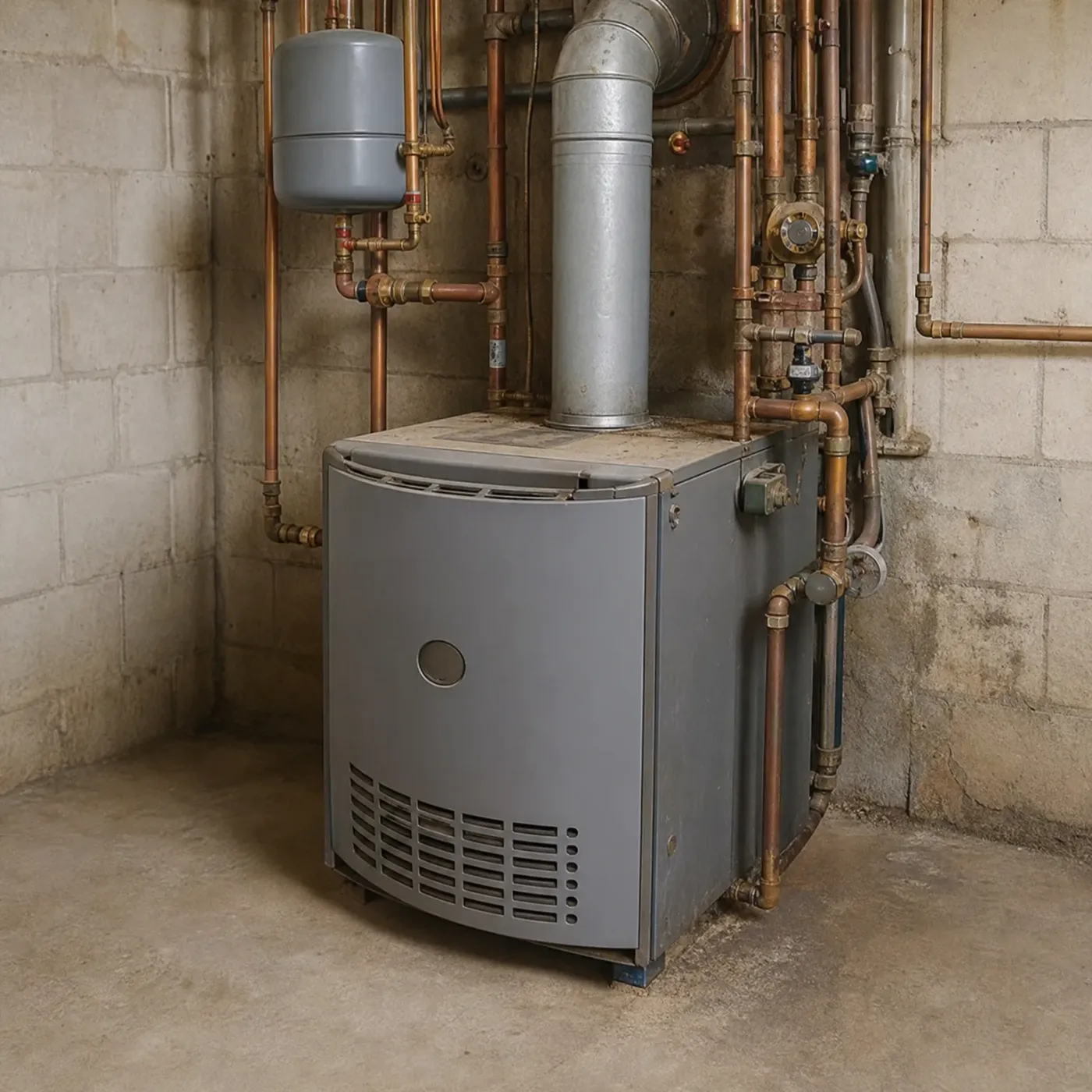
A gray residential boiler with a metal flue pipe stands in a concrete-block basement corner, surrounded by copper piping, valves and a gray expansion tank.
Before you get your boiler maintenance
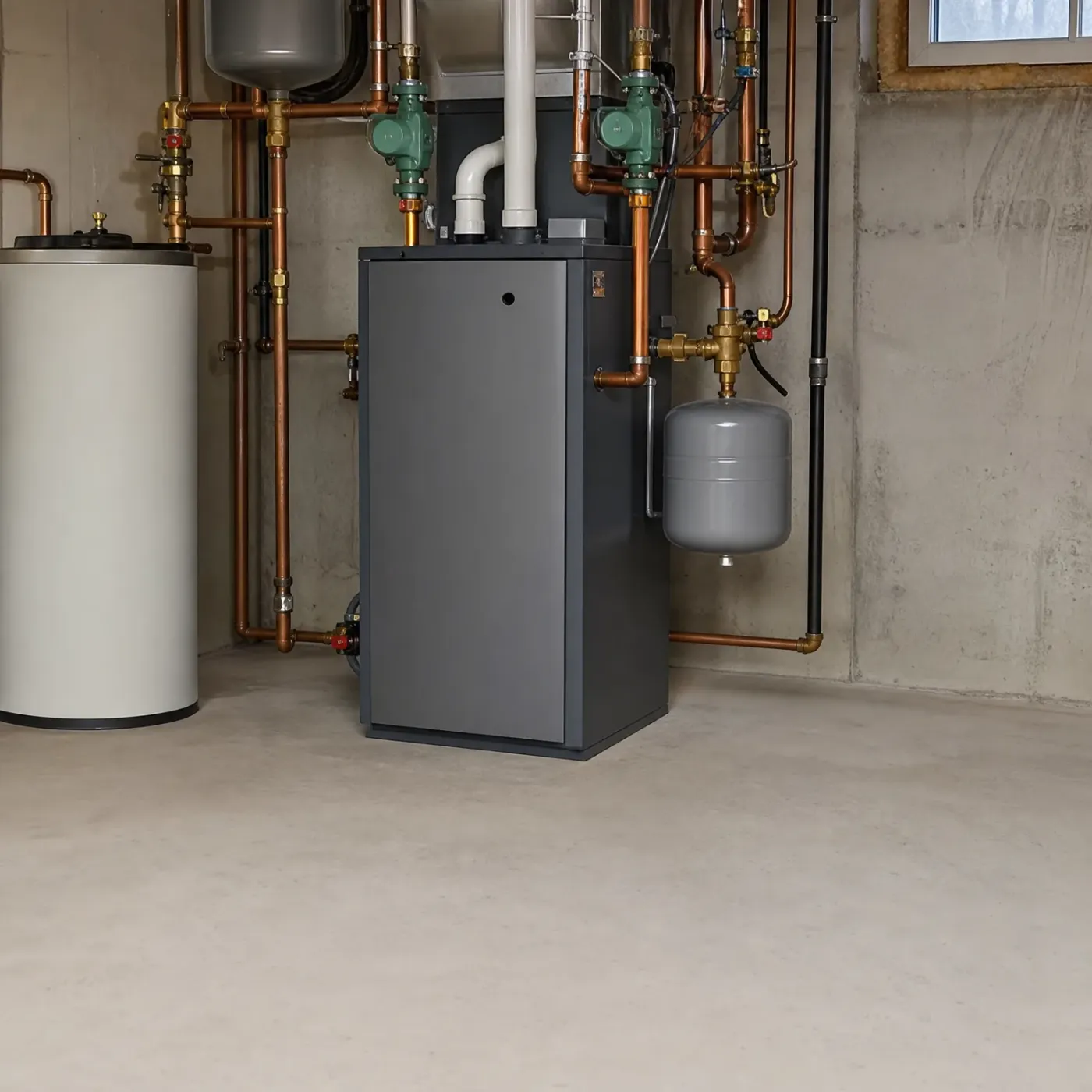
A dark gray floor-standing boiler in a concrete-walled basement, connected to copper piping, circulator pumps, a gray expansion tank, and a cream-colored storage tank to the left.
After you get your boiler maintenance
  1. Gas and power get shut off before any panel comes off.

  2. The burner cover comes off to check flame color and shape.

  3. A combustion analyzer checks the flue gases against spec.

  4. Water pressure gets tested cold, then checked again hot.

Winter nights average 48°F

A 48°F night is right at the edge where your boiler decides it's worth turning on. It won't run long or often at that temperature, so a problem like a drifting pilot or a slow pressure leak can go unnoticed for weeks before it shows up as a cold house.

NOAA nClimDiv 1991-2020

A boiler in League City doesn't need much from you most winters, which is exactly why a quick check before December is worth it. Nothing about your system changes because of the visit except that the things that quietly go wrong, a pressure that's drifted, a pilot that's unsteady, scale building in the heat exchanger, get caught while they're still small. The contractor who comes out is local, works on boilers like yours all year, and knows which of these problems shows up most in homes around here. You'll hear from one contractor, not a handful of companies competing for the job, so there's no pile of calls to sort through. Once you send the request, the search is done. You're not left comparing names or waiting to see who calls back first. Someone who already knows this equipment takes it from there.

A curving paver walkway runs alongside a house with beige lap siding and a white-trimmed window, bordered by low shrubs, grassy plants, and trees in sunlight.
A dark-framed casement window with divided upper panes set in a stucco wall beside a stone-clad section, with hydrangeas, hostas and trimmed shrubs in a mulched bed above a lawn.
White horizontal lap siding wall with a single six-pane double-hung window, above a mulched bed of hydrangea shrubs with browning blooms, bordered by mown grass in low sunlight.
Interior corner with tan plaster walls, a potted olive tree in a large terracotta urn beside a floor-to-ceiling window, and a wooden bench with a beige cushion on a herringbone brick floor partly covered by a woven jute rug.
A wooden bench beneath a window holds a green linen cushion and a fringed cream throw, with a woven basket stored underneath on a wood plank floor.

Done looking for a boiler pro

The pro who gets in touch is licensed in Texas and works in Galveston County.

Find a local pro

No fee to send it, and nothing to sign.